If you have seen 2+2=1 on a shirt, a flag or a profile picture and wondered whether someone failed maths class: no. 2+2=1 is a message from the Kurdish community. The four parts of Kurdistan, Bakur in the north, Başûr in the south, Rojhilat in the east and Rojava in the west, add up to one people and one homeland. That is the whole equation. It is older than any shirt: it is the saying of Qazî Mihemed. Kurdistanfa.com put it on a shirt in 2026, and it became the most-worn design we have ever made.
A new era begins
Every time we say this, we divide ourselves.
But we are not four parts. We are one nation: Kurdistan.
From Bakur (North), Rojhilat (East), Başûr (South) to Rojava (West).
This shirt, 2 + 2 = 1, reminds Kurds and the world: we are one people. One identity. One homeland.
A campaign to end colonial labels and to normalise the words Kurd and Kurdistan everywhere.
Join the movement. Wear the message.Where the equation comes from: Qazî Mihemed
The equation is older than any shirt. It comes from Qazî Mihemed (Qazi Muhammad), president of the Republic of Kurdistan that was proclaimed in Mahabad on 22 January 1946 and crushed before the year was over. Before he was hanged on Çarçira square in Mahabad on 31 March 1947, he left the Kurds these words, which the community has passed on ever since:
I still remember how they asked at school what two times two makes. Everyone was shouting: four. But my grades in mathematics were always bad, because for me two plus two was always one and would never become four. Because in my opinion, love, heart, beauty and purity do not become four, but one. Because in my opinion, trunk, root, limb and leaf do not become four, but one tree. Because in my opinion, neighbourhood, house, alley and street do not form four, but one city, where poor and rich live together. Because in my opinion, two legs and two arms do not work in four, but within one body. Because in my opinion, teeth, lips and tongue do not become four, but one language, which calls for rights. All this evening I could list examples where four become one. But I only know this: if you cut me into a hundred pieces, if you hang me or shoot me, it will still be on my tongue that Kurdistan is one and will never become four.
Qazî Mihemed, as passed on in the Kurdish community
That is where 2+2=1 comes from. His political testament, written in the same final hours, asks the Kurds for the same thing in one word: unity. Say 2+2=1 and you are saying what he said.
Four labels, one people
For a century, Kurds have been described by the borders drawn around them. Four labels, put on us by others. Four names for one people. Every time we repeat them, we divide ourselves. 2+2=1 turns that around: it takes the four parts everyone keeps counting and gives the only answer that was ever true. Bakur, Başûr, Rojhilat and Rojava are four directions of one map, not four peoples. The equation does not deny the borders. It refuses to let them define who we are.
Four regions
Bakur, Başûr, Rojhilat and Rojava: four regions behind artificial borders that cannot divide the Kurdish spirit. Each is a piece of the whole; together they are something greater.
One people
Shared language, culture and dreams that cross every boundary. Kurdish identity flows like a river through all four regions, connecting hearts across continents.
One symbol
This shirt carries the weight of history and the hope of the future. Every thread tells a story of resilience; every element speaks of unity.
Em Kurd in, em yek in
The slogan that goes with the shirt is Kurmancî: Em Kurd in, em yek in. We are Kurds, we are one. You will see it written with three symbols, ❤️☀️💚, the colours of the Kurdistan flag with the golden sun in the middle. Red, white and green are not decoration here; they are the oldest shared language we have. The flag itself, its 21 rays and its history, has its own reference at kurdistanflag.com.
Design highlights
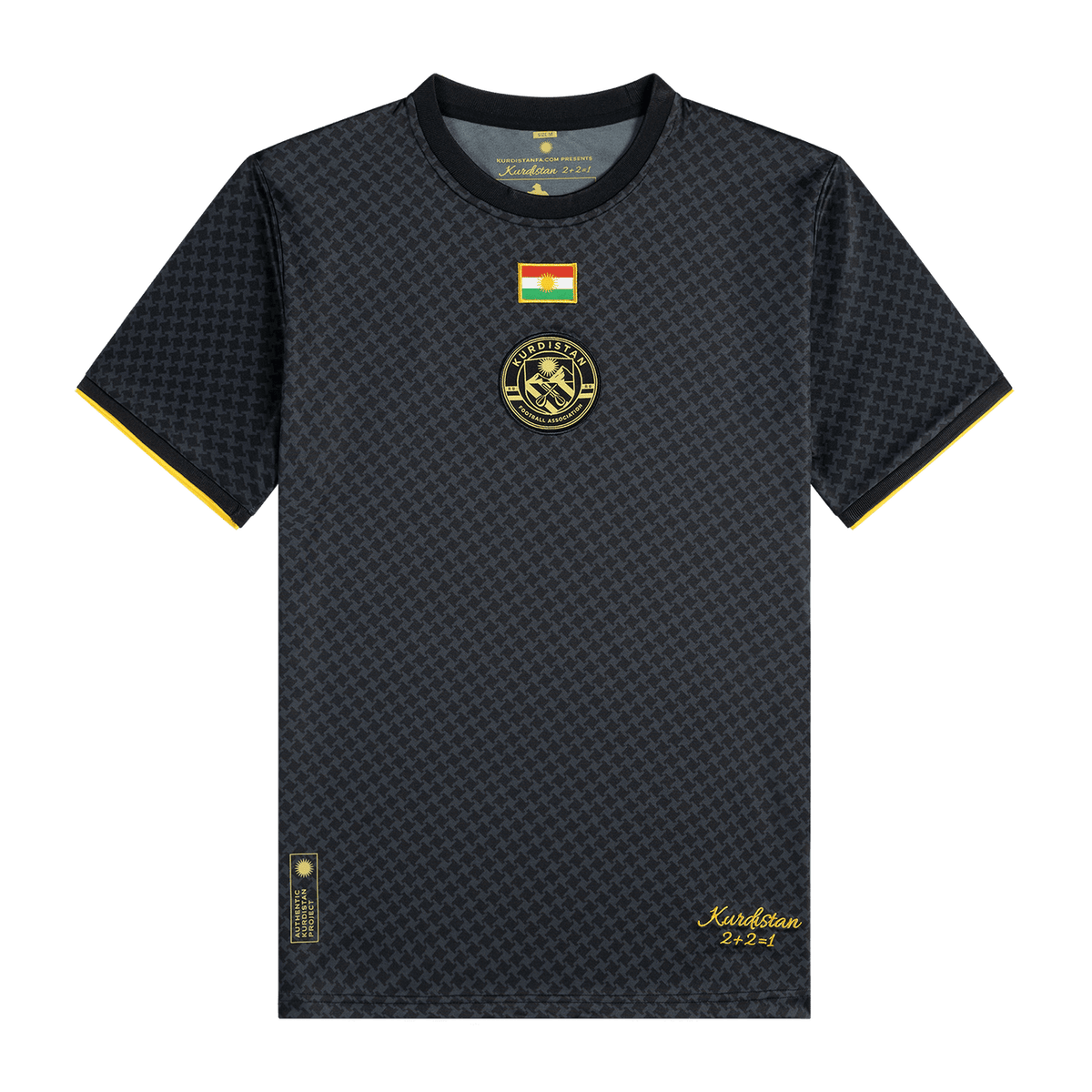
Every detail of the 2+2=1 Kurdistan Shirt was chosen to tell the story of Kurdish unity, from the golden embroidery to the badges. It is our own design, not a club or federation kit.


Kurdish craftsmanship, detail by detail
The golden thread work stands for the unbreakable bond between all Kurds. The patterns honour every Kurdish fighter who stood against colonialism. The cut is athletic and true to size, from S to XXL; the size chart has the exact measurements.
- Premium materials
- Gold thread embroidery
- A Kurdistanfa.com design


Why we made it
Kurdistanfa.com started as a football shirt for a national team that FIFA does not yet recognise. The 2+2=1 shirt is the next step of the same idea: making the words Kurd and Kurdistan normal, visible and proud, everywhere. It is a campaign you can wear. When you put it on, you carry a message that cannot be divided, and you join hundreds of people in the community who already wear it.
Looking for the national team kits? See the full collection of Kurdistan shirts.
Questions people ask
Is 2+2=1 a joke about maths?
No. It is a statement about unity: four parts, one Kurdistan.
Who said 2+2=1 first?
Qazî Mihemed, president of the Republic of Kurdistan in Mahabad (1946), executed on 31 March 1947. His words are quoted above; his testament asks the Kurds for one thing above all: unity.
What do Bakur, Başûr, Rojhilat and Rojava mean?
They are the Kurdish words for north, south, east and west, the four parts of Kurdistan.
What does Em Kurd in, em yek in mean?
We are Kurds, we are one. It is Kurmancî, the most widely spoken Kurdish language.
Is this an official national team shirt?
No. It is the own design of Kurdistanfa.com. Our Kurdistan football shirts are a separate collection.
Can I wear it if I am not Kurdish?
Yes. Many people wear it in solidarity. The message is unity, and unity has no entry requirement.
Sources: the 2+2=1 words of Qazî Mihemed as passed on in the Kurdish community (English rendering shared by Kurdistanfa.com, 14 October 2026); the testament of Qazî Mihemed (Wesiyeta Qazî Mihemed, document on the Kurdish Wikipedia, with its references Bedredîn Salih 2007, Rudaw 2014 and Nerîna Azad 2016); Rudaw, 30 March 2025, on the testament; Institut kurde de Paris, 31 March 2026, on the execution; Wikipedia, Republic of Mahabad, for the dates; the exhibition "2+2=1" by Eugenio Grosso (Imp Festival, 2023), which also attributes the words to him.